How emulation works on this handheld
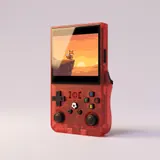
The R36 Max doesn't contain the hardware of the original consoles. It recreates them in software. It boots into an open-source Linux system and shows an EmulationStation-style menu that sorts games by system. Behind that menu, most systems rely on RetroArch cores, small emulators that each specialize in one console. All of this runs on a Rockchip RK3326, a quad-core Cortex-A35 chip clocked up to 1.5 GHz, with a Mali-G31 MP2 GPU and 1 GB of RAM. It's an efficient, well-known platform, and it's what sets the limits described below.
Storage uses two microSD cards. The TF1 card, on the right, holds the system. The TF2 card, on the left, holds your games. Units ship with a factory Linux image, sometimes ArkOS depending on the batch. Community firmware is also available, such as ArkOS builds made for the R36 Max. Switching firmware is at your own risk, so always back up both cards before you change anything.
Systems that run well
8-bit and 16-bit consoles are the RK3326's home turf. Their games need very little power, so the processor has headroom left for the display filters and save states the emulator offers. The Game Boy family falls into the same category: those handhelds were designed around modest hardware, and emulating them stays light. Classic arcade games are another strength, especially the oldest cabinets, with one caveat: compatibility depends on the emulator you use and the version of your game files.
PS1 is where the comfort zone tops out. Many games run well on default settings, while others need a tweak or a different core. The two analog sticks, set in the lower corners, come into play for games that use them, and the four shoulder buttons, L1, L2, R1 and R2, mirror the controller layout of that era.
| System family | Realistic expectation | Notes |
|---|---|---|
| 8- and 16-bit consoles | Runs well | The RK3326's home turf, with headroom to spare |
| Game Boy family | Runs well | Game Boy nearly full screen, wider formats with bars |
| Classic arcade | Runs well | Depends on the emulator and the file version |
| PS1 | Many games run well | Some need a tweak or a different core |
| N64, PSP, Dreamcast | Depends on the game | Results vary widely by game and settings |
| PS2 and later | Out of reach | Hardware limit, no setting changes it |
Systems that depend on the game
With N64, PSP and Dreamcast, the RK3326 reaches the edge of what it can do. These consoles used more demanding 3D, and emulating them puts far more load on the processor and GPU. Results vary a lot from game to game and with your settings: some games stay enjoyable, others slow down or show graphics or audio glitches. There's no simple rule, and no one can guarantee that a specific title will run properly on this chip.
If these systems interest you, treat them as a bonus to explore rather than a reason to buy. Firmware matters too: the same game can behave differently from one system image to another. Depending on the options your emulator offers, a few tweaks often make a difference:
- try a different RetroArch core for the same system
- lower the internal resolution or turn off graphics enhancements
- turn on frame skip if the option is available
- compare with another firmware version, after backing up your cards
Out of reach: PS2 and beyond
PS2 isn't on the menu for the R36 Max, and later generations even less so. Cortex-A35 cores are built for power efficiency, not raw performance, and 1 GB of RAM isn't enough to recreate those machines. No setting, no faster card and no community firmware changes this hardware limit. It's a matter of design, not a defect. Better to know that before you buy than to find out while setting up your cards.
If PS2 or a newer console is your priority, this isn't the right device for you. The R36 Max aims at something else: a broad retro library, from the earliest home consoles up to PS1, in a compact handheld body with two sticks, four shoulder buttons and a 4000 mAh battery. For that library, its chip is well matched.
The square screen vs. 4:3 and handheld formats
The 4-inch IPS screen displays 720 × 720 pixels in a 1:1 aspect ratio, about 254 pixels per inch, on a fully laminated panel. Most retro home consoles output a 4:3 picture. Shown without stretching, a 4:3 game keeps its proportions, with bars above and below. Since the screen is nearly as wide as an R36S screen, a 4:3 image appears at a similar size: the extra height mainly benefits squarer formats and menus.
Handheld systems fit differently. The nearly square Game Boy image fills a large part of the panel. Wider formats, like Game Boy Advance or PSP, leave taller bars. Display options such as stretching, scaling or filters depend on the system and the emulator. The R36 Max we sell is the original square-screen model, not the R36 Max2 with its 4.5-inch screen.
Legality: what you can play
The real question isn't the device but the games: an emulator is software, and the R36 Max is a Linux-based device. Only play games you have the right to use: your own backups of games you own, where your local law allows it, homebrew made by independent developers, and games their creators distribute for free. Rules on backup copies vary widely from country to country.
This guide doesn't link to any game files and doesn't promise any titles or game counts. It isn't legal advice either: if you're unsure, check with a reliable legal source where you live. The homebrew scene is a great place to start, with recent releases designed for 8- and 16-bit consoles.
Frequently asked questions
Will a 128 GB microSD card make games run smoother?
No. Card capacity changes how many games you can store, not performance, which depends on the RK3326 and the emulator. Usable space after formatting is also lower than the stated capacity. The device accepts cards up to 128 GB, and the TF2 card, on the left, is the one that holds your games.
Do demanding emulators drain the battery faster?
Generally, yes. The 4000 mAh battery offers up to 6 h announced by the manufacturer, but real-world runtime depends on brightness, volume, the emulator and the game. An N64 or PSP game works the processor harder than an 8-bit game. Lowering the brightness is the easiest way to stretch a session.
Can you play online with the R36 Max?
The R36 Max has no built-in Wi-Fi and no Bluetooth. Depending on the firmware, a USB Wi-Fi dongle plugged into the USB-C OTG port may work, but it's sold separately and isn't guaranteed to work. Online play isn't a feature to count on: this device is made for offline gaming.
Does an R36S or R36 Ultra emulate better?
No. All three use the same RK3326 processor with 1 GB of RAM, so they share the same emulation limits. The differences lie elsewhere: the R36S has a 3.5-inch 4:3 screen, while the R36 Ultra shares the square screen and adds built-in Wi-Fi with a 3000 mAh battery. The R36 Max stands out with its 4000 mAh battery and sculpted grips.
Sources
- Handhelds Wiki, R36MAX
- Retro Catalog, R36 Max specifications
- Retro Handhelds, R36MAX first impressions (December 2024)
Our guides are based on the supplier's product sheets and public documentation. We don't claim any hands-on testing.